institution closures almanach

Library

1995 (Demolition), 1996-99 (Composition) Samuel R. Delany, Times Square Red, Times Square Blue (New York University Press, 2019).
July 1794 / posthumous Saint-Just, “Fragments d’institutions républicaines,” in Œuvres complètes, ed. Michèle Duval (éditions Gérard Lebovici, 1984), pages 966-1009. Miguel Abensour edited a more recent edition in 2004. The only (?) English translation seems to be that of @rbzpr on Tumblr: “Fragments on the Republican Institutions (Louis Antoine Saint-Just) - @rbzpr on Tumblr,” translated by @rbzpr, RBZPR, <Tumblr, web archive>. [The translation of Saint-Just linked above still has to be checked for needed corrections, and in any case we should try to get in touch with @rbzpr to free it from Tumblr by mid-February 2026.]
One of the most generous resources and introductions to Saint-Just’s “republican institutions” is Miguel Abensour’s “The Theory of Institutions and the Relations of the Legislator to the People According to Saint-Just” (1967/68), which can be downloaded on-site [here (fr)]. His references are, as mentioned, incredibly helpful, instructive, but really go beyond any instrumentality. We have made most of them available in digest form below. The digest in question really constitutes a second page to this bibliography and scaffolds its own network of references:
Montesquieu
Helvetius
Rousseau
Hume
Boissy d‘Anglas
Brissot
Babeuf
Sade
Saint-Just
Dézamy
Proudhon
Marx
Hauriou
Renard
Gourvitch
Deleuze
(Consult the Abensour reference digest, below, for detail on these names and their arrangement.)
1740-1752, 1953 Gilles Deleuze, Empiricism and Subjectivity: An Essay on Hume’s Theory of Human Nature, trans. Boundas (Columbia University Press, 1991), especially for its developments concerning atomism and association (26-7), the positivity of the moral world and its invention (e.g. 30, 40), the latter as fiction and “feigning” (69, 79-80, 128) and its positivity as habit (throughout); finally, the production of solidarity at a distance as a positive task (32, 37-51, “sympathy”). Deleuze’s own bibliography to Instincts and Institutions (1953) is available in totality here.
From Empiricism and Subjectivity:

“The problem of society … is not a problem of limitation, but rather a problem of integration. To integrate sympathies is to make sympathy transcend its contradiction and natural partiality. Such an integration implies a positive moral world, and is brought about by the positive invention of such a world. […]

The moral and social problem is how to go from real sympathies which exclude one another to a real whole which would include these sympathies. The problem is how to extend sympathy. […]

In an artificial way, the nearest must become the most distant, and the most distant, the nearest.” (39-40)

1994 Jacques Derrida, Politics of Friendship, trans. George R. Collins (Verso, 1997), esp. concerning enmity, “fraternity” and distance.
1795 Hegel, “The Positivity of the Christian Religion,” in On Christianity, trans. Knox (Harper Torchbooks, 1961), regarding “the Republic”, the critique of possessive individualism as world-loss, and an illustration of the intrinsically political and polemical nature of modern concepts of “society”: pages 154–59 and 165. Its sequels or afterlife shadow “Sittlichkeit”, “Gattungswesen”, “Gemeinwesen”, “Geselligkeit”, “community” and “society”. Characters include (very contradictory ones) Henriette Herz and Schleiermacher’s theory of the “sociable” salon (1799), Feuerbach (~1840), Durkheim (1893 and 1912), Tönnies’ Community and Society (1887/1912) subtitled “Treatise on Communism and Socialism as Empirical Patterns of Culture”, Simmel and Weber, Mauss (total social fact 1925), ellipsis: in short, the lineage constitutive of “Sociology” whose object (“society”) is inextricable from the political quarrel which, in the 1790s, was still narrated in an epic form as the story of the fall of the Roman Republic as the myth of the birth of capitalism.
1817-18, 1820 Lectures on Natural Right and Political Science, trans. Stewart and Hodgson (University of California Press, 1995), section 134 including its long remark (only slightly indented after the first paragraph); Elements of the Philosophy of Right, trans. Wood, trans. Hugh Barr Nisbet (Cambridge University Press, 2012), Hegel’s remark to section 273 and addition to section 274. Law is a knowledge of social form, but the making of the social cannot be grasped as the mere declaration of laws; a constitution is not given from without to a heap of atoms. The revolution was already social, not blank slate. The perspective of “founding” can be misleading.
1851, 1908, 1932-34 1) Karl Marx, “The 18th Brumaire of Louis Napoleon,” from Marx/Engels Collected Works, Vol. 11: 1851-1853, (International Publishers, 1979), which reflects on the problem of recognizability. The bourgeois revolution borrowed costumes and poetry from the past, Napoleon as Caesar. Marx asserts that these costumes will no longer serve. An epic of critique must replace them. 2) In Reflections on Violence, Sorel takes stock of its insufficiency; another epic is needed. He calls on “myth” to give plausibility to collective action, and proposes the image of the “general strike”. 3) Gramsci’s Prison Notebook 13: Jottings on the politics of Machiavelli, known as The Modern Prince, asks which myth can hold the morning after when the abstract equality of a riot must organize, endure, and differentiate. Again a problem with the perspective of beginnings. 4) A wider bibliography includes Castoriadis’s The Imaginary Institution of Society (1975), Freud’s Totem and Taboo (1912-13), Mass Psychology and Analysis of the I (1921), and Civilization and its Discontents (1930) as well as Lacan’s The Other Side of Psychoanalysis (1971-72). 5) On the historical contingency of the heaviest boulder in our way, see Anderson, Benedict, Imagined Communities: Reflections on the Origin and Spread of Nationalism, third edition, Verso, 2006.

(Jot of 12/7/2025, updated 12/17, 1/9 and 1/22.)

Miguel Abensour’s References for “Republican Institutions”

Montesquieu
Helvetius
Rousseau
Hume
Boissy d‘Anglas
Brissot
Babeuf
Sade
Saint-Just
Dézamy
Proudhon
[Clastres]
Marx
[Bergson]
Hauriou
[Schmitt]
Renard
Gourvitch
[Shariati]
[Tosquelles]
Deleuze
[Deligny]
[Oury]
[Guattari]
On the left, pre-Revolutionary thinkers; the second column, which really should include Rousseau, remains instrumental. For Babeuf, Sade, and Saint-Just, republican institutions are not an instrument of republican education, unity, or virtue, but a sea change, an overthrow of the law itself as synonym for political humanity. The revolutionaries of the fourth column hold this rift. Where bracketed names appear, they go beyond Abensour’s explicit text. Bergson, Hauriou bring Schmitt as stowaway and this destabilization is not resolved in what follows. Institutional psychotherapy, to which Abensour does not refers, is here included in brackets around Deleuze in roughly chronological order.
1748, 1959 Montesquieu, for whom society (climate and national character) pre-exists the state (De l’esprit des lois). See Althusser’s Montesquieu (PUF: Paris).
1758 Helvetius, De l’esprit. (Legislator as educator.)
1762, 1782 Rousseau, Émile, ou De l’éducation; Considérations sur le gouvernement de Pologne regarding the need of religion to produce virtue amidst the lower classes, “faire aimer les lois”.
May 8, 1793 Brissot, journalist and among the founders of the Girondin tendency, wrote in a letter: “Je voudrais distinguer et la partie organique du gouvernement et les institutions morales qui font aimer le gouvernement, qui corrigent les défauts et perfectionnent les qualités du caractère national, qui inspirent cet enthousiasme de la liberté et de la patrie... Dans tous, excepté dans celui de Saint-Just, je ne vois que la partie organique: il semble qu’on ait pris les hommes pour des automates et qu’on ait cru au pouvoir de les gouverner avec les lois de la mécanique.”
1794 Boissy d’Anglas, Essai sur les fêtes nationales.
The preceding three references have something in common, which sharpens Saint-Just by contrast. Abensour writes: “À la différence de J.-J. Rousseau, de J. Brissot, de F. Boissy d’Anglas, Saint-Just n’a pas une conception exclusivement instrumental de l’institution. [...] L’institution n’a pas pour objet de faire respecter par une voie indirecte les termes du contrat, mais de repousser toute fondation contractuelle de la société pour atteindre à une fondation institutionnelle.” “L’institution est fondation d’un ordre spécifique: la cité de droit social; elle découle d’une conception positive de la société et d’une théorie de la socialité originaire.” (284f in the original publication, 129f in Cœur de Brutus.) (What of Sorel’s myth and Gramsci’s party? do they belong with Rousseau and Boissy d’Anglas’s instrumental religion?)
December 1794 / 8 vendémiaire l’an III Babeuf, Tribune du peuple 19, pp. 3-4 on the “great legislative doctors [grand médecins législatifs]”.
November 1795 / 9 frimaire l’an IV Babeuf, Tribune du peuple 35: “We have greater need of institutions than of constitutions.”
1843, Code de la communauté by (early!) materialist and communist revolutionary Théodore Dézamy. Abensour writes: “Il en résulte une transformation du rôle du législateur, plus lecteur que créateur: ‘Toute la mission du législateur consiste à les rechercher, à les reconnaître, puis à les promulguer.’ Si T. Dézamy ne prononce pas le mot institution, il en conçoit la pensée…””
1849 Proudhon, Confessions d’un révolutionnaire: “It is because society has never been organized, but is merely in the process of organization, that, until today, it has needed legislators, statesment, heroes and police commissioners.” This passage passage can’t be found on page 56 where Abensour places it, yet others nearby are pertinent and just as striking. On page 60, we read, “Je distingue en toute société deux espèces de constitutions, l’une que j’appelle la constitution SOCIALE, l’autre, qui est la constitution politique: la première, intime à l’humanité, libérale, progressive, et dont le progrès consiste le plus souvent à se débarrasser de la seconde, essentiellement arbitraire, oppressive et rétrograde.” See also Chapter XVIII regarding revolutionary clubs:
“Certes, après la Révolution de février faite au nom du droit de réunion, du droit qu’ont les citoyens de discuter entre eux les intérêts du pays, et de manifester solennellement leur opinion sur les actes du pouvoir; après, dis-je, cette affirmation éclatante de l’initiative populaire, s’il était une institution qu’un pouvoir démocratique dût respecter, et non-seulement respecter, mais développer, organiser, jusqu’à ce qu’il en eût fait le plus puissant moyen d’ordre et de paix : c’étaient les clubs. Je dis clubs, comme je dirais meetings, sociétés populaires, casinos, gymnases, académies, congrès, comices, etc.; en un mot, associations et réunions de toute nature et de toute espèce. Le nom ne fait rien à la chose. [...] Le Gouvernement provisoire s’était contenté de faire surveiller les clubs : il s’est beaucoup vanté de sa tolérance. Tolérer ! c’était déjà se déclarer hostile, c’était renier son principe. Après la tolérance, devait infailliblement venir l’intolérance. Cavaignac donna le signal ; l’atrabilaire Léon Faucher, trouvant l’œuvre de son prédécesseur insuffisante, entreprit de la compléter. Un projet de loi fut déposé par lui, qui déclarait purement et simplement l’interdiction des clubs.”
1910, 1927, 1930, 1932 1) Maurice Hauriou, Principes de droit public (Paris: Sirey, 1910). Hauriou was a Bergsonian and a Catholic conservative, and an influence on Carl Schmitt, whose subordination of law to a greater sovereign mirrors Hauriou’s elevation of social and “living” right over formal right. 2) Gaston Morin, La Loi et le Contrat (Paris: Alcan, 1927) and “Vers la révision de la Technique juridique. Le concept d’institution” in Archives de Philosophie du droit et de Sociologie juridique nos. 1-2 (1931). This issue also contains a long essay of Georges Gurvitch on Maurice Hauriou. 3) Georges Renard, La Théorie de l’institution. Essai d’ontologie juridique (Paris: Sirey, 1930). 4) Georges Gurvitch, L’Idée du Droit social. Notion et système du Droit Social. Histoire doctrinale depuis le XVIIe siècle jusqu’à la fin du XIXe siècle (Paris: Sirey, 1932). Gurvitch begins with Proudhon and concludes with a critique of Hauriou. — Prevalence among these titles of the publication house Société du recueil J.-B. Sirey. — This list (or lineage) extends to Ali Shariati who studied with Gurvitch. — Schmitt’s quiet entry into this bibliography gives pause.
1953, 1967 Hauriou and Gurvitch show up in a footnote to a question: “What are the theoretical presuppositions of the notion of institution?” This footnote concludes with Gilles Deleuze, whose Empiricism and Subjectivity: An Essay on Hume’s Theory of Human Nature (1953), Instincts and Institutions (1953), and Coldness and Cruelty (on Sacher-Masoch, 1967) Abensour cites elsewhere in the article. “From a philosophical point of view,” he writes, it is worthwhile to consult Mauss and Fauconnet’s entry on “Sociologie” in the Grande Encyclopédie are worth consulting; but “most of all [principalement] the several works of G. Deleuze already cited...”
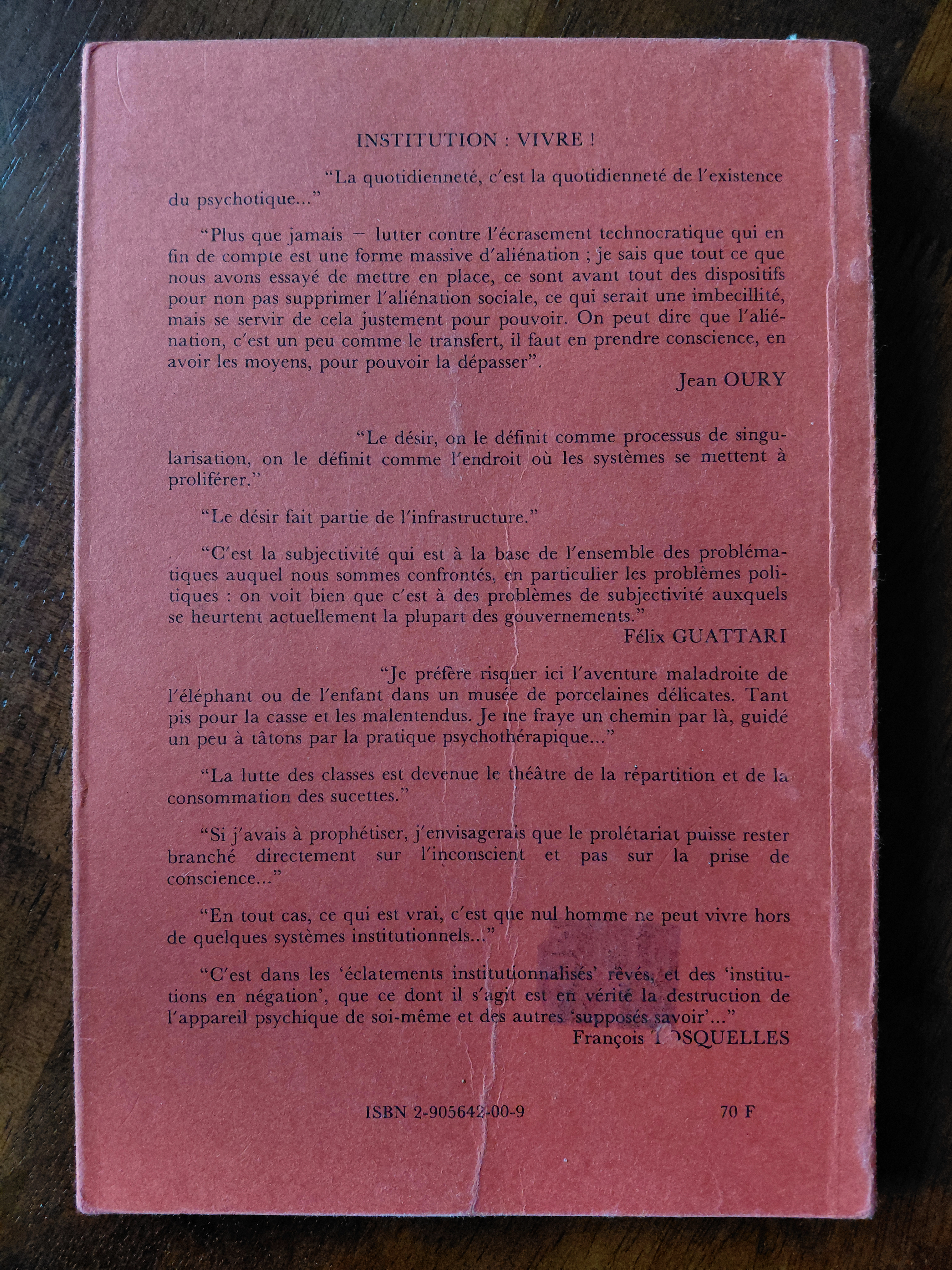

(Combed 1/7-9, 2026.)

Instincts and Institutions (1953)
Deleuze’s Reference Table

(Pulled from Deleuze’s Instincts et Institutions on 1/9/2026.)

convolut/momey