“Institutions”
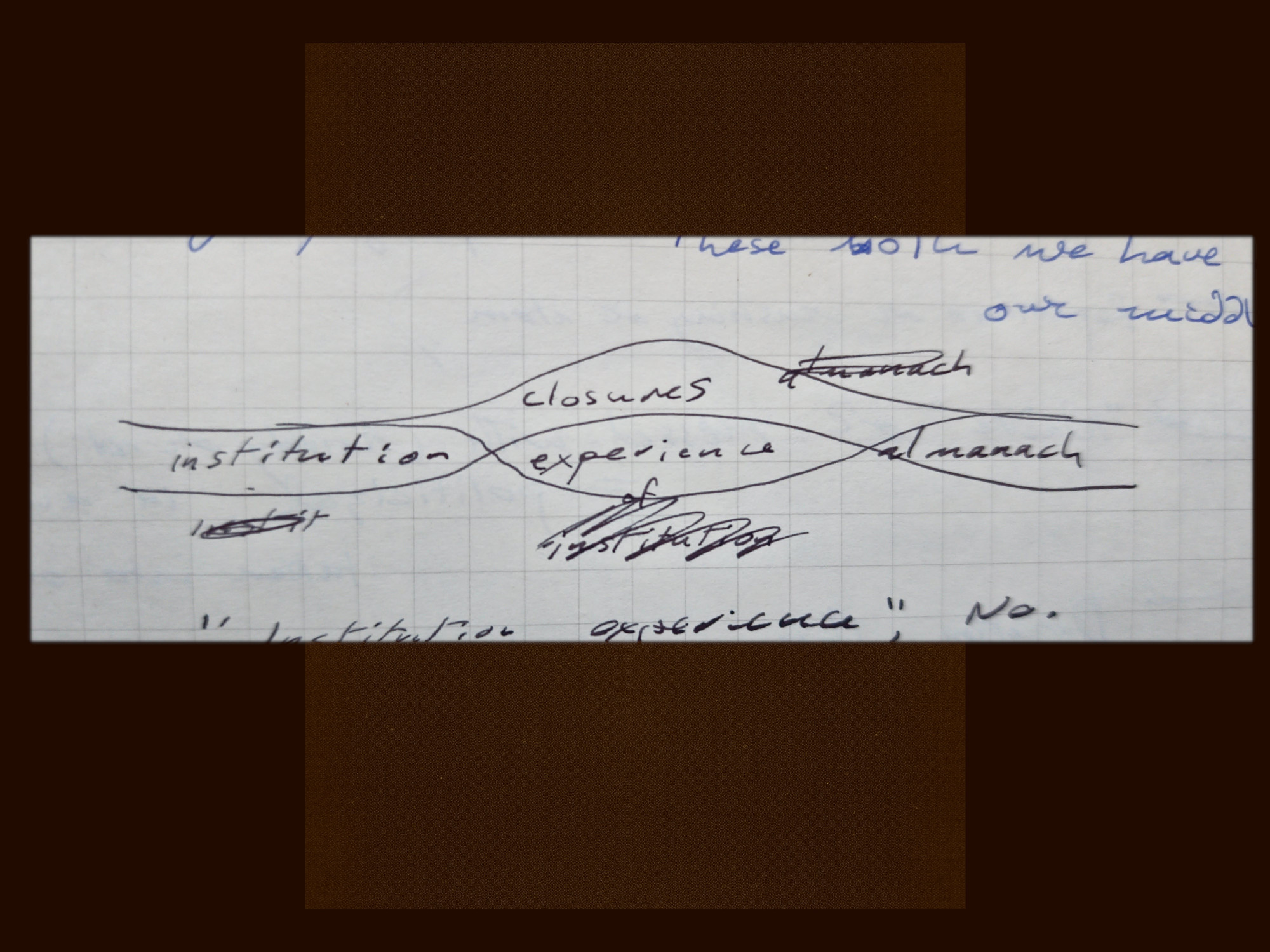
While trying to explain this project, I learned to start from the following clarification: we are not talking about “the Institution,” as one often names the system of authorities, schools, museums, foundations that certify cultural production. Minor institutions are our object. A corkboard in a small bookstore which happens to be the most queer-friendly space within 100 miles, a solidarity cantine in a squat, workday lunches always more crowded. A women’s bookstore in Milan. A philosophy department whose power as a gathering place outdoes even its professors’ offerings and gives their teaching the hungriest ears. An call-in radio show broadcast live from and to indigenous reservations. The everyday presence in the student lounge of Tehran University of those who won academic sanctuary 20 years ago. A farm in the mountains where the nonverbal and the speaking have learned to live together. “Republican institutions” of collective possibilities (1794). Not Danto’s but Saint-Just’s, Tosquelles’s and Deligny’s.
And Samuel Delany’s. His cinemas, the porno theatres of Times Square pre-1995, belong on this list. Their closure compelled Delany to document them not as facts but as practices, collective practices which exceeded the individuals who made use of the spaces which these practices sustained. His twinned essay Times Square Red, Times Square Blue tries to save and pass on the experience of this institution—not his experience of it but the weathered knowledge that was in the institution itself.
“However indirect, my argument’s polemical thrust is toward conceiving, organizing, and setting into place new establishment—and even entirely new types of institutions—that would offer the services and fulfill the social functions provided by the porn houses that encouraged sex among the audience.
What was there was a complex of interlocking systems and subsystems. Precisely at the level where the public could avail itself of the neighborhood, some of those subsystems were surprisingly beneficent—beneficent in ways that will be lost permanently unless people report on their own context and experience with those subsystems.
The polemical passion here is forward-looking, not nostalgic, however respectful it is of a past we may find useful for grounding future possibilities.”
Samuel Delany in Times Square Red, Times Square Blue
Our bow tie of the closure and experience of institutions, which Obiits.org sets as its program, is a hand-me-down from Delany.
The closures are a fact. What follows must draw what effects its siblings, “institutions” and the “experience” of institutions, are hoped to have.
Society and Community
Why “institutions”? What is this word supposed to do? It is a proposal for thinking about collective power, its crazy varieties, its learning. This felicitous word, “institutions,” minds a gap which other words leave unworked between two customary ways of thinking about human collectivity.
“Society” is on another scale, quite maximal, which Marcel Mauss calls a “fait total,” a “total fact.” Kinship structures are an example, relations of production too. A total fact has to be taken or left as a whole. You can’t, for example, take part of the social contract and leave the rest. Society is total, all or nothing. And there’s only one of it. An institution is something smaller, and there are many of them.
“Community” is of another color. The word is charged. It seems to name something local, a unity and union in presence and proximity. Community is, additionally, understood to be something concrete and thus opposed to the distance, abstraction, and artificiality of law and bureaucracy. At the same time, it names what was lost to atomization, enclosure, and colonization.
The union we’ve lost to this many-armed disaster is itself preconceived by its role as an ideal. Proximity, presence, locality seem like a “natural” side of human gregariousness, dismembered by abstraction and artifice. Community as ideal has important things to teach, or at least express, but two of its lessons absolutely must be unlearned. 1) Rejecting artifice, it relegates human agency to the “artificial” field of law, leaving only a very poor conceptual apparatus to think their agency in their communal relations. 2) Emphasizing unity, it too overlooks the multiplicity of smaller institutions of collectivity which overlap, interplay, conflict, develop within a community. In fact, there is no total community, but a stable interplay of multiple communities which is refined to a unity by means an image (for example, a flag). (On the shelf, Ferdinand Tönnies’ Community and Society, Benedict Anderson’s Imagined Communities.)
We must make this dimension of social facts into something we can talk about, facts that are not untouchable hoverings in the structure or all-or-nothings of joining or leaving society or idealized communities modelled on love.
We need a name for this other dimension. Something within in our reach, something maniable. The need for this concept is the main point. Terminologically, “institutions” will do. The word is often used this way: by Saint-Just in particular in his posthumous “Fragments of Republican Institutions”. But to avoid confusion, it’s essential to completely sideline the dominant connotation of the word in English today, that of being “The Institution”, in the singular, something big, major, central, capital. The institutions we are chronicling are many, heterogeneous, often peripheral. Neither one nor all, but some. Medium-sized. Though these days we often see them defunded or closed by a state, their making requires much more than the prince’s signature. People make them together.
Attributes and Gradients
Institutions are many. One “passes through” many of them with every step one takes. Thus one can hardly be fatalist regarding institutions.
“Membership” is only one sort of belonging. They permit ephemeralities: visitors, guests. Some of them exist above all for those with no other public for expression, dialogue, research, publication. (Favret-Saada in Vacarme 28: “J’ai trouvé dans l’expérience, les écrits, et le milieu analytiques un appui que mes collègues ethnologues me refusaient. / In the psychoanalytic experience, writings, and milieu, I found the support which my colleagues in ethnography refused me.”)
They can span distances, render distances viable, render differences sharable.
They are of many sizes, and their size matters.
The Rabbis said that institutions (of one, of two, of five, of nine) share amidst themselves a word and an experience of learning, or do not; with this learning comes a kind of spiritual presence, and absent it, something ugly. (Pirkei Avoth 3:2, 3:3, 3:6.)
The concept of institution contains something disjunctive. They can form little dictators, little servants. Or they can produce something one would describe as collective. But, once again, “collective” has not one but many, many forms. It is not the most helpful concept to presuppose, unless one is ready to enter into the rhythms and humors of a specific collectivity.
Institutions are lost and made but above all kept, reproduced, and mutated.
Founding vs. Reproducing
At a moment in which one has lost many institutions, one comes to reflect on the conditions of their making and founding. Certain children (this author included) dreamed in manifestos and grew up to wish for a future in our ways of being together. The perspective of “founding” must be viewed with caution as we conceptualize institutions. Why? Because it is the characteristic of unhappy times to start from nothing.
What are you doing, when you found? Catching a bunch of atoms in a bag? If so, this is the pre-history of an institution. Its concept lies rather in what comes later, in a life that is not that of atoms.
The perspective of “founding” might make us think founders are needed. Such great names, to paraphrase Saint-Just, had the misfortune of living in times without institutions.
The perspective of “founding” might make us think that institutions are made by laws, rules. But they are only proposals. Additionally, they are proposals written in an alphabet we must already share, at least partly. But without thinking first about what we already share, we fail to see that they are not the founder’s making, but a collective one. Even for us today, when someone founds something—maybe better to say “initiates” or “occasions” something—what they do is create a situation, not write a story.
The perspective of “founding” might make us lose, finally, the creativity of their duration. I repeat: the creativity of institutions is not in their beginning, but in their duration, of their reproduction. Dividing the two according to a gendered schema of reproduction and production or the classic division between intellectual and manual labor yields a founding that is either fruitless or unaware of the ruse of the collective pressing within it; and a collective which misunderstands its power and above all its importance in the institution’s life and future.
Institutions have been closed, atoms set loose, but it would be a mistake to believe that we are left with just atoms. The concept of institutions must formulate a spectrum from inchoate to recognizable, and another (distinct) spectrum from unfigured to explicit.
When one recognizes these gradients: smaller and larger, inchoate and recognizable, unfigured and explicit, dictatorial and collective, one develops an eye. One sees them. One sees that they are everywhere. And at the same time that they are rare.
The perspective of “founding” lets us think that we know something about institutions when we read a bylaw or a manifesto. We do not. The knowledge of institutions is in their reproduction, not in their founding. This reproduction, or rather, this collective making, is what makes an institution different from a piece of paper. Pieces of paper and certainly correspondences, messages, calls and emails are part of the life and creative reproduction of an institution when they are exchanged. But the knowledge of institutions, if it is not in the document given in advance, is in its middle, in midstride.
This knowledge is one of experience. Every institution, at the same time as it is a constant creation and mutation, is also a constant learning.
Another spectrum consists in the way this learning is made available. Of course, this act, of making available, is not exclusively of the institution’s own life, but also of their reader.
(Draft of January 12, 2026. In process. Write to contact ɐ obiits ◊ org with amendments and additions or questions and reactions. For the previous draft, [click here].)
If you would, please communicate your reactions, questions and associations to contact ɐ obiits ◊ org; please also flag passages that are unintelligible.